Posts

Glory of Solitude

Image
The world has become precariously chaotic. It is easy to be wafted by this chaos but to creatively confront it a deliberate seclusion is necessary to return with deeper conviction and greater impetus. Solitude is the refusal to succumb to the incognizance of the world. Momentum demands withdrawal; a withdrawal which is ephemeral. We withdraw not because we fear but to never fear again. Solitude is such a withdrawal with a noble motive to know ourselves deeper; to know our fragility, strength, weakness, vulnerability, fear, emotional stability etc. Solitude is a battle with the self to realize our basic being. It is in solitude that the true nature of a person springs. As a deacon I would further say that a cleric is neither known through his Liturgy nor his speeches but through his casual conversations and in his solitude. My constant prayer is “God may the vestments adorn my heart; not my body.” People naively think that solitude and loneliness are the same which is false....

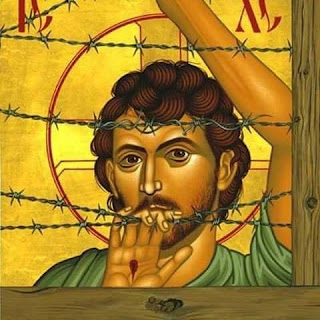
Face of God

Image
Incarnation was an attempt of God to rekindle the extinguished embers of divinity in human hearts. An initiative to wake humans from their slumber and to make them realize that a full human is akin to God. Christ is the saturation of humanity. This reminds me of St. Athanasius the Great, the pillar of orthodoxy who profoundly remarked “God became man so that man might become God”. This principle is known as ‘theosis’ and is the kernel of Orthodox Theology. I now invite your attention to Genesis 33:10 where Jacob says to his brother Esau “For truly to see your face is like seeing the face of God since you have received me with such great favour.” What supernaturalism did Esau do to have been bestowed by such attestation? Nothing. He just forgave. So do remember when we forgive our face resembles the face of God. Forgiveness is one such divine attribute among many which lay indolent in the abyss of human ignorance. The Lord’s Prayer puts forth before us just one condition. In ...

Home: An Emotion

Image
Homes are not just defined on the coordinates of time and space rather it is an emotion. The grief of leaving our homes could make us sick (homesick). Then imagine the trauma of those refugees whose emotion of home is colonized by the bureaucrats and the systemic evils of the world. Houses could be built but homes are not the niche of an architect, they evolve; not just out of the blue but through sheer sacrifices, compromises, endurance, hope and pain. Homes are the concrete expressions of human abstraction. When people are made to be homeless it is not just rendering them space-less rather you take a toll on their humanness. Devoid of homes means devoid of emotions and bereft of emotions humans are just a mass of flesh. Theologians and faith leaders add impetus to this. Eulogizing the ordeals of exile through the intervention of a divine force makes suffering and endurance sacrilegious. Resilience turns to be an inert cognizance in this entire process. What has gone wrong...

Crippled by choice

Image
Humans dread the freedom offered by Christ and relish in the slavishness of law. How smartly have we fortified Christianity with rigidified fences of legalism! The all-embracing Ecclesia initiated by Christ at the expense of his sweat and blood has now been exclusively institutionalized as the Church with dogmatic and doctrinal impediments. This made Christopher Lynn Hedges, an American journalist, Presbyterian minister, and Princeton University professor to write; Paul Tillich wrote that all institutions, including the church, are inherently demonic. Reinhold Niebuhr asserted that no institution could ever achieve the morality of the individual. Institutions, he warned, to extend their lives when confronted with collapse, will swiftly betray the stances that ostensibly define them. Only individual men and women have the strength to hold fast to virtue when faced with the threat of death. And decaying institutions, including the church, when consumed by fear, swiftly push t...

Paradox of Sin

Image
Sin is a concept which has been made to be exploitative in nature. The augmentation of sin consciousness among the faith community has always been directly proportional to the flourishing of the Church. Bring into your memories the greatest ecclesiastical vice of the Medieval Christianity – Indulgence.   Indulgence, to be precise, was the act of selling forgiveness initiated by the Roman Catholic Church. Leo X, the then Pope in Rome, to support his extravagant lifestyle and to raise funds for St. Peter’s Basilica resorted to the use of a new fund-raising scheme—selling forgiveness of sins. For a fee, the bereaved relatives could get a deceased loved one out of Purgatory. At the right price, they could also save up for their own future sins. Johann Tetzel, a Dominican friar, makes this explicit, “When a penny in the coffer rings, a soul from Purgatory springs.” It was predominantly against this systemic evil, Martin Luther protested, which led to the Protestant Reformation – ...

Listen Uninterruptedly

Image
People who vent out their emotions are usually considered to be weak. This is so absurd. It requires great courage to weep and feel the pain of embarrassment. Jesus never withheld his emotions but expressed them unabashed. He was not even ashamed to weep something which the toxic masculinity prohibits a man to do. Our basic understanding of masculinity itself is skewed. Men are expected not to be emotionally friable and thus we see men camouflaging their emotional fragility through anger, resentment, restlessness and the like. Men are culturally conditioned to believe that the lacrimal gland which secretes tears is only present in women. Falling prey to the expectations of society we have forgotten our basic existential being. Sarah Rich remarks; When school officials and parents send a message to children that “boyish” girls are badass but “girlish” boys are embarrassing, they are telling kids that society values and rewards masculinity, but not femininity. They are not ju...

Joy of Communion

Image
The most ancient and sacred temple is the human body as it came into existence with the breath of God. Incarnation was all about a man attempting to discover the vestiges of divine characteristically present in human flesh but we interpreted it as God taking flesh, clearly undermining the quest for the divine initiated by a human. Over the years, this interpretation has created a void in the intrinsically indwelling relationship between the humans and the divine. Incarnation in its inception vouched for freedom but our insular hermeneutics has given it the connotation of servitude. Communion of being has been usurped by the subject-object dichotomy. The joy of discovery has been conquered by the burden of intrusion. After all, to acknowledge the fact that the divine and human are inseparable is a discomforting reality. Freedom necessitates accountability, thus humans chose to remain enslaved by inquisitively creating a different realm for the divine. The attempt then was to...